Trane ComfortLink II Controls in Pasadena
Trane models desk - updated 2026-06-13
Quick answer: Pasadena Trane HVAC sets up and troubleshoots Trane ComfortLink II controls across Pasadena ZIPs 91101 through 91107, diagnosing comm faults before replacing a $400 to $2,000 board - so call (213) 277-6575 or book online. The XL824 and XL850 communicating touchscreens run variable-speed staging and show plain-language fault alerts.
At a glance
- ComfortLink II controls: XL850 (TCONT850) and XL824 (TCONT824) communicating touchscreens.
- Required to unlock variable-speed staging on XV20i (4TWV0) and XV18 (4TWV8) systems.
- Surface plain-language fault alerts (e.g., loss of comms with the outdoor unit).
- Built-in Nexia / Z-Wave bridge; pairs with the Trane Home app.
- Comm faults usually trace to the 4-wire bus, a failed board, or low voltage.
- Control or communicating board replacement $400-$2,000 in 2026 SoCal.
- Service ZIPs 91101-91107. Independent - not a Trane dealer.
What does ComfortLink II actually do?
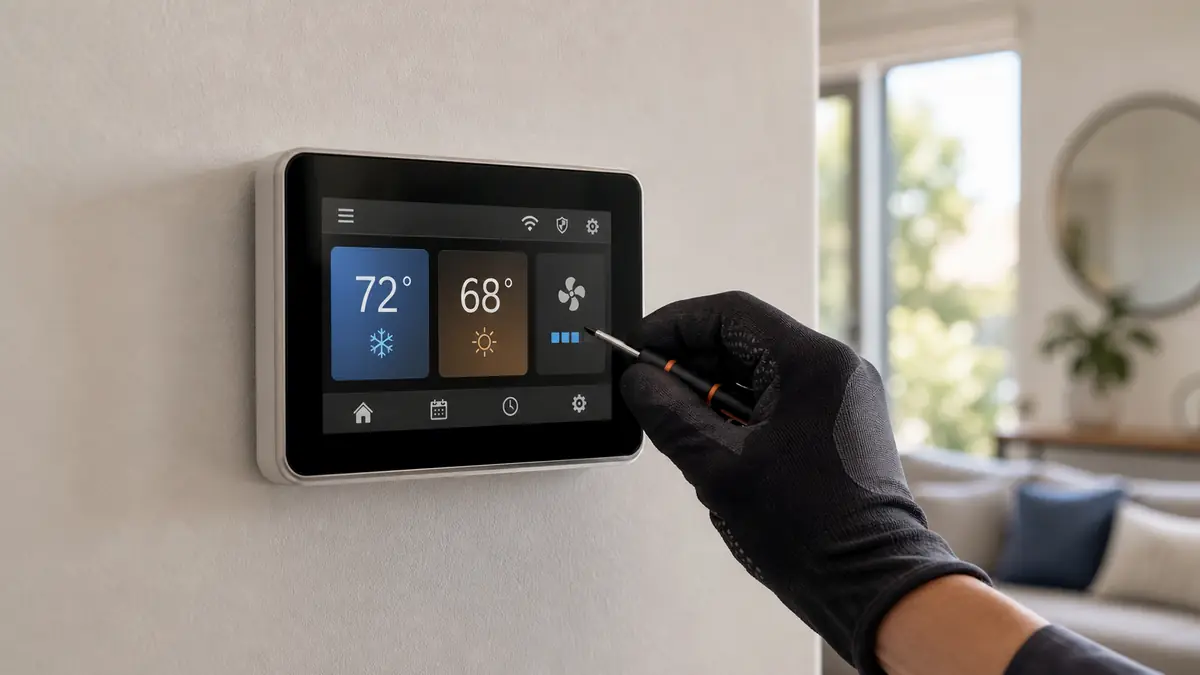
ComfortLink II is Trane's communicating platform. Instead of simple on/off thermostat wires, it runs a 4-wire data bus between the XL824 or XL850 thermostat, the indoor air handler or furnace board, and the variable-speed outdoor unit. That two-way link is what lets a 4TWV0 modulate its Climatuff compressor through its full range and what lets the system report a fault in words rather than a blinking LED.
| Control | Use case | Notes |
|---|---|---|
| XL850 (TCONT850) | Top-tier variable-speed systems | Color touchscreen, built-in Nexia/Z-Wave |
| XL824 (TCONT824) | Variable-speed and communicating systems | Color touchscreen, Wi-Fi, Nexia |
| XR724 / XR402 | Non-communicating single-stage XR | Programmable / Wi-Fi, no comm bus needed |
How do you fix a ComfortLink II communication fault?
A loss-of-communication alert is the most common ComfortLink II call. We do not start by swapping boards. The 4-wire bus is the first suspect: a corroded terminal in a damp Pasadena crawlspace, a wire nicked during a prior service, or a connector backed out by vibration. We check continuity and voltage end to end, confirm the outdoor unit has line power, then test the indoor and outdoor communicating boards only if the wiring is clean. Replacing a $1,500 board to fix a loose wire is exactly the waste we avoid.
What ComfortLink II alerts mean and what we check
Unlike a furnace flash code, ComfortLink II reports in plain language on the touchscreen and in the Trane Home app. That is a real advantage - the alert often names the subsystem - but it still takes diagnosis to separate a wiring fault from a failed board.
| Alert | Likely cause | What we check first |
|---|---|---|
| Loss of communication with outdoor unit | 4-wire bus or low line voltage | Continuity end to end, line power at disconnect |
| Loss of communication with indoor unit | Bus to air handler / furnace board | Connector seating, corroded terminals |
| System runs single-speed, no staging | Control missing or mismatched | Confirm XL824/XL850 paired to the inverter unit |
| Intermittent dropouts | Vibration-backed wire, nicked insulation | Wiring inspection at the cabinet penetrations |
| No display / dark thermostat | 24V power, transformer, or thermostat fault | 24 volts at the control, then the thermostat |
The discipline is the same every time: prove the wiring before condemning a board. A corroded terminal in a damp Pasadena crawlspace mimics a dead PCB, and replacing a $1,500 board to chase a loose wire is exactly the waste we refuse to bill for.
What does ComfortLink II ask of the wiring in an older home?
The 4-wire communicating bus is more sensitive than old on/off thermostat wiring, and Pasadena's housing stock complicates it. Many 1900-1930 Craftsman and 1920s revival homes have thermostat wire that was run decades ago, sometimes only the 2 or 3 conductors a simple thermostat needed - a communicating control wants a clean 4-wire run. Damp crawlspaces and attics corrode terminals, and a wire nicked during a prior service shows up as an intermittent dropout months later. On a new variable-speed install we pull fresh, correctly gauged communicating wire rather than reusing a tired legacy run, because the staging and the diagnostics both depend on a solid bus.
Why does the control choice depend on the equipment?
We match the control to the system, not the other way around. A single-stage XR air conditioner gains nothing from a communicating thermostat, so a standard programmable unit is the right, cheaper choice. A variable-speed heat pump or AC must have the XL824 or XL850 or it cannot stage - buying the equipment without the control wastes the upgrade. We confirm the pairing during any install.
How do you set up a ComfortLink II control correctly?
A communicating control is only as good as its commissioning. After the bus is wired and verified, the XL824 or XL850 runs through an equipment-detection routine that should find the indoor and outdoor units automatically - if it does not, that points back to a wiring or addressing problem, not a defective thermostat. From there we set the system parameters that actually shape comfort and efficiency: the variable-speed staging behavior, the airflow per stage, the backup-heat lockout temperature on a heat pump so the strips do not run on a mild day, and the dehumidification target that matters during a humid Santa Ana spell. We connect it to the Trane Home app and confirm the alerts come through, then walk you through reading them. A control left on factory defaults often staffs the wrong stage for a Pasadena load, which quietly wastes the variable-speed system you paid for.
ComfortLink II versus a basic programmable thermostat
The tradeoff is capability against simplicity and cost. A ComfortLink II control is mandatory on a communicating variable-speed system - it is the only way to run the staging and read the plain-language diagnostics - but it is more expensive and depends on a clean 4-wire bus. A standard programmable or smart thermostat (the XR724 or XR402 tier) is cheaper, works over ordinary thermostat wire, and is the correct choice on a single-stage XR that has nothing to communicate. We never put a communicating control on equipment that cannot use it, and we never strand a variable-speed unit on a thermostat that cannot stage it.
Common questions about Trane ComfortLink II in Pasadena
What does 'loss of communication with outdoor unit' mean on my XL850?
ComfortLink II runs a 4-wire bus between the thermostat, indoor board, and outdoor unit. That alert means the connection dropped - a loose or corroded wire, a failed communicating board, or low line voltage to the outdoor unit. We check the wiring and voltages before replacing a board.
Do I need a ComfortLink II thermostat for my Trane?
Only if your system is communicating. A variable-speed XV20i or XV18 requires an XL824 or XL850 to run its staging; without it the unit drops to single-speed. A single-stage XR works fine on a standard non-communicating thermostat, so we do not push a control you do not need.
Can I see Trane fault alerts on my phone?
Yes. The XL824 and XL850 connect through the Trane Home app (built on the Nexia platform), which surfaces the same plain-language alerts the thermostat shows. We often read the app history with you to confirm a fault before we arrive.
What is the difference between the XL850 and the XL824?
Both are ComfortLink II communicating color touchscreens that run variable-speed staging and show plain-language alerts. The XL850 (TCONT850) includes a built-in Nexia and Z-Wave hub for home-automation control; the XL824 (TCONT824) adds Wi-Fi and Nexia at a lower price. For most Pasadena homes the XL824 is plenty unless you want the Z-Wave hub.
Will a Nest or Ecobee work on my variable-speed Trane?
No - not to run the staging. A variable-speed XV20i or XV18 communicates over the ComfortLink II 4-wire bus, which third-party thermostats do not speak, so a Nest or Ecobee would force the unit to single-speed and waste the upgrade. A single-stage XR, by contrast, works fine with a standard smart thermostat.