Trane Furnace 2 Flashes in Pasadena
Fixes desk - updated 2026-06-13
Quick answer: A Trane furnace flashing 2 times in Pasadena, CA means a system lockout after too many failed ignition tries, usually a weak igniter, dirty flame sensor, or gas-supply fault on a cold 91103 night, so call (213) 277-6575 or book online and we restore safe ignition.
At a glance
- 2 flashes = system lockout after too many failed ignition attempts.
- Top causes: dirty flame sensor, weak hot-surface igniter, gas-supply fault.
- Pasadena pattern: idle mild-winter furnaces lock out on the first cold snap.
- One reset is fine; a repeat lockout is a real part, not a glitch.
- Fix lanes: igniter or flame sensor $150-$400; control board $400-$900.
- Service ZIPs 91101-91107. Hours: Open 6:30am-8pm weekdays, 8am-5pm weekends.
- Independent - not a Trane dealer.
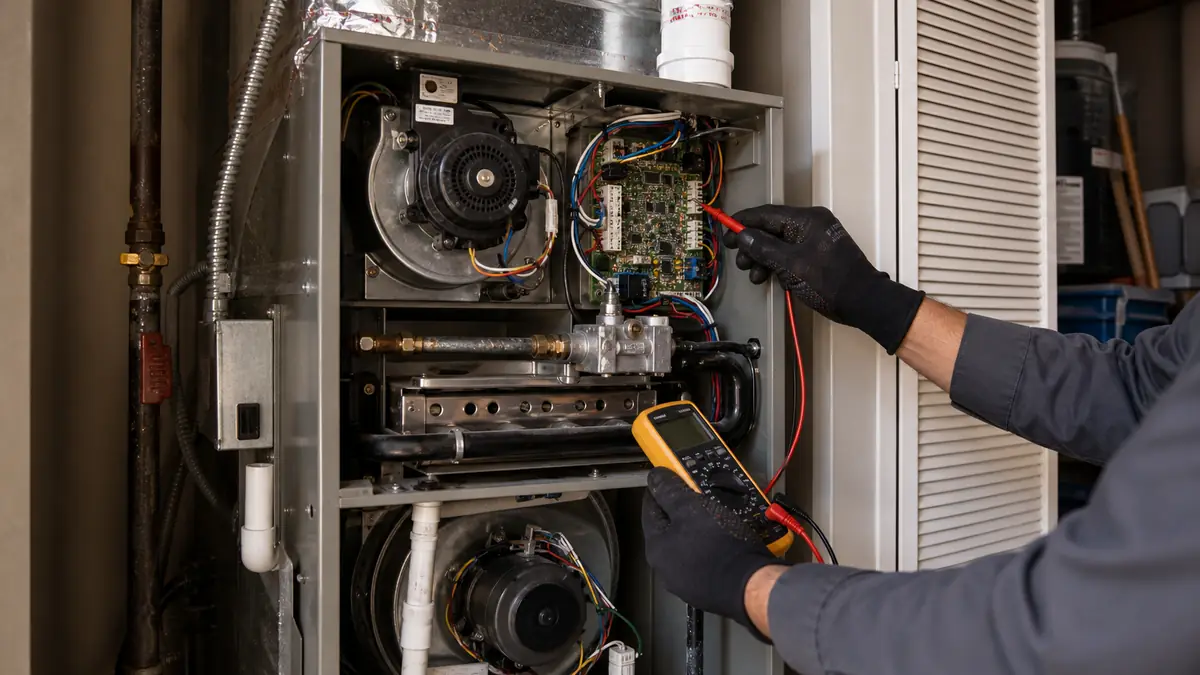
What does 2 flashes mean on a Trane furnace?
Two blinks on the control-board LED is the system-lockout code on Trane and American Standard furnaces. To understand it you have to follow the ignition sequence the board runs every time it calls for heat. The inducer starts and proves draft through the pressure switch. The hot-surface igniter glows. The gas valve opens. Then, within a few seconds, the flame sensor - a thin metal rod in the flame - must confirm that the burners actually lit by passing a tiny flame-rectification current measured in microamps. If the board does not see that current, it closes the gas valve, waits, and tries again. Trane controls allow a set number of tries, typically three, before they stop. After the last failed try, the board declares a lockout and flashes twice.
So a 2-flash code does not point to one part. It means the furnace attempted to light and could not confirm a stable flame, then protected the home by refusing to keep dumping gas. The diagnosis is figuring out which link in that chain broke.
Why does a Trane lock out in Pasadena winters?
Pasadena's climate shapes this fault. Sitting in Title-24 Climate Zone 9 against the San Gabriel foothills, the city has short, mild heating seasons, so a furnace can sit unused for months. That idleness is hard on two ignition parts. The flame sensor slowly grows an oxide or silica film while it sits, and that film insulates it so it reads too few microamps even when the flame is fine. The hot-surface igniter, a brittle silicon-carbide or silicon-nitride element, ages and develops micro-cracks; it still glows but no longer reaches the temperature needed to light gas reliably. Both are fine all summer and reveal themselves the first cold morning the furnace is asked to work.
That is why our 2-flash call volume spikes on the season's first real cold snap across Bungalow Heaven, Garfield Heights, and the estates near 91103. The larger historic homes add a gas-supply angle: long, old gas runs and aging valves can deliver marginal manifold pressure, so the burners light weakly and the flame sensor cannot lock in. Spanish Colonial and Tudor revivals with furnaces tucked in tight closets or attics also tend to accumulate dust on the sensor faster.
What can a homeowner safely check?
- Confirm the thermostat is calling for heat and set above room temperature, with fresh batteries if it uses them.
- Check that other gas appliances work. If the water heater or range is also out, the gas supply is the issue - if you smell gas, leave and call the utility first.
- Replace a dirty filter; severe restriction can interrupt the sequence indirectly.
- Reset once: furnace off at the switch or breaker for 30 seconds, then on, and watch one full ignition attempt.
- If it lights and stays lit, note it. If it runs the inducer, glows, tries, and locks out at 2 flashes again, stop and book service.
Cleaning the flame sensor is the one repair that tempts homeowners, and while light - the rod unscrews and a gentle pass with fine abrasive pad restores it - it puts your hands next to the gas burners and live ignition wiring. We do not recommend it unless you are comfortable there; a sensor reinstalled wrong or a cracked igniter handled roughly creates a worse problem than the lockout.
How do we diagnose a 2-flash lockout?
We test the ignition chain in the order the furnace runs it, with instruments at each step, so we replace the part that actually failed rather than the easiest one to reach.
- We watch a full ignition cycle and note exactly where it fails - no glow, glow but no flame, or flame that lights then drops out.
- We meter flame-sense current in microamps on the running burner. A reading well below the Trane minimum (often under about 1 microamp where several are expected) is a fouled or failing sensor.
- We ohm the hot-surface igniter and watch its glow. An open or visibly weak igniter, or one out of its resistance range, gets replaced.
- We put a manometer on the gas valve and verify manifold pressure against the rating plate; low pressure points upstream to supply or the valve.
- We confirm a clean ground, because flame rectification needs a solid ground path - a corroded burner ground mimics a bad sensor.
Most Pasadena 2-flash calls end at step two or three: a flame sensor cleaned or replaced, or an aged igniter swapped, and the furnace lights on the first try again. Only when those check out do we look at the gas valve or control board. For the full code chart see Trane furnace error codes, and for the hands-on repair scope visit Trane furnace repair.
When is a 2-flash lockout an emergency?
A lockout with no gas smell is a no-heat problem, not a hazard - the furnace shut the gas off, which is the safe outcome. Handle it as an emergency only in specific cases. If you smell gas at any point, leave the house and call the gas utility before anything else. If other gas appliances are also dead, treat it as a supply issue and get it checked the same day, especially during a cold snap with vulnerable residents at home. And resist the urge to reset over and over: each reset runs the inducer, glows the igniter, and briefly opens the gas valve, so chained resets cycle gas into a furnace that is not lighting it. One reset, then book. For a fast lockout fix in any of the 91101 to 91107 ZIPs, call (213) 277-6575 or book online and we will get the burners proving flame again.
Common questions about a Trane 2-flash code in Pasadena
What does 2 flashes mean on a Trane furnace?
Two flashes is a system lockout. The furnace tried to light its burners, failed to prove flame within its allowed number of tries, and shut itself down for safety. It will stay locked out until the retry timer expires or you reset power. The cause is almost always on the ignition side - a weak hot-surface igniter, a dirty flame sensor, or a gas-supply problem.
How do I reset a Trane 2-flash lockout?
Switch the furnace off at the wall switch or breaker, wait 30 seconds, then turn it back on. That clears the lockout and the furnace will attempt a fresh ignition sequence. Watch it: if it lights and stays lit, a one-time glitch may have caused it. If it runs through its tries and locks out at 2 flashes again, the fault is a real part and resetting repeatedly will not fix it - book a diagnostic.
Why does my Trane lock out on cold Pasadena mornings?
Pasadena winters are mild, so the furnace sits idle for long stretches. During that downtime the flame sensor oxidizes a thin film and an aging hot-surface igniter weakens. The first hard cold morning demands ignition the worn parts can no longer deliver, and the furnace locks out at 2 flashes. It is why we see a wave of lockout calls on the season's first cold snap across Pasadena.
What does it cost to fix a Trane 2-flash lockout in Pasadena?
The common fixes are inexpensive: cleaning or replacing a flame sensor or a hot-surface igniter runs about $150 to $400. A gas-supply or gas-valve fault costs more, and a failed control board lands around $400 to $900 installed. The diagnostic is $79 to $200 and is credited toward an approved repair, so you only pay the diagnostic once.