Trane Furnace 4 Flashes in Pasadena
Fixes desk - updated 2026-06-13
Quick answer: A Trane furnace flashing 4 times in Pasadena, CA means an open high-temperature limit, so the furnace overheated and tripped its safety, almost always from restricted airflow in an older 91104 home; call (213) 277-6575 or book online and we find the airflow restriction.
At a glance
- 4 flashes = open high-temperature limit (furnace overheated and shut off the burners).
- Leading cause is restricted airflow, not a failed limit switch.
- Airflow culprits: clogged filter, dirty coil, undersized return, weak blower.
- Never jumper or bypass the limit - it guards against heat-exchanger cracking.
- Fix lanes: airflow $150-$600; limit switch $150-$350; blower/ECM $450-$2,300.
- Service ZIPs 91101-91107. Hours: Open 6:30am-8pm weekdays, 8am-5pm weekends.
- Independent - not a Trane dealer.
What does 4 flashes mean on a Trane furnace?
Four blinks on the control-board LED is the open high-temperature limit code on Trane and the identical American Standard furnaces. Inside the cabinet, a high-limit switch sits in the supply-air stream just above the heat exchanger. It is a normally-closed thermal switch set to open at a fixed temperature - commonly in the 160 to 200 F range depending on the model. When supply air gets hotter than that setpoint, the switch opens, the control kills the gas valve and burners, and the blower runs on to carry the trapped heat away. The board logs the open limit as four flashes.
The key thing to understand is that the limit switch is doing exactly what it should. It is a safety, not the failure. A 4-flash code is the furnace announcing that it overheated and protected itself. Our job is to find why it overheated, and in Pasadena that answer is airflow far more often than a faulty switch.
Why does my Trane overheat in a Pasadena home?
Heat output is fixed by the burners, so the only way a furnace overheats is if not enough air moves across the heat exchanger to carry that heat into the house. Less airflow means hotter supply air, and hotter supply air opens the limit. In Pasadena the airflow restriction usually traces to the home itself. The pre-war Craftsman bungalows in Bungalow Heaven and Historic Highlands were built around small, undersized 1920s ducts and a single skinny return that cannot feed a modern Trane furnace its rated cubic feet per minute. Add a pleated filter that has not been changed since summer cooling season, and the coil sitting above the furnace caked with dust, and the airflow drops below what the limit can tolerate.
We also see it in Madison Heights and Linda Vista when homeowners close registers in unused rooms to "save energy," which actually starves the system and trips the limit. Furniture or a rug over a floor return does the same thing. The mid-century ranches fare a little better on duct size but still suffer from neglected filters. Across the 91101 to 91107 footprint, the pattern holds: the 4-flash code is an airflow story first.
What can I safely check before calling?
- Turn the furnace off at the wall switch or breaker for 30 seconds, then back on, to reset the lockout once.
- Pull the filter. If it is gray, clogged, or you cannot see light through it, replace it with the same size and a similar (not denser) rating.
- Walk the house and open every supply register and return grille - all of them, including unused rooms.
- Move furniture, rugs, or boxes off any floor or wall return.
- Restart and watch. If it heats normally, airflow was the cause. If it flashes 4 again, stop cycling it and book a diagnostic.
That sequence clears a large share of 4-flash calls without a truck. What you should never do is bypass the limit switch with a jumper or replace it just to silence the code. The limit is the last line protecting the heat exchanger; defeat it and the steel can overheat and crack, which vents combustion byproducts including carbon monoxide into the supply air.
How do we diagnose a 4-flash limit code?
When a clean filter does not solve it, we measure rather than guess. The instruments tell us whether the problem is airflow or a genuinely failed component.
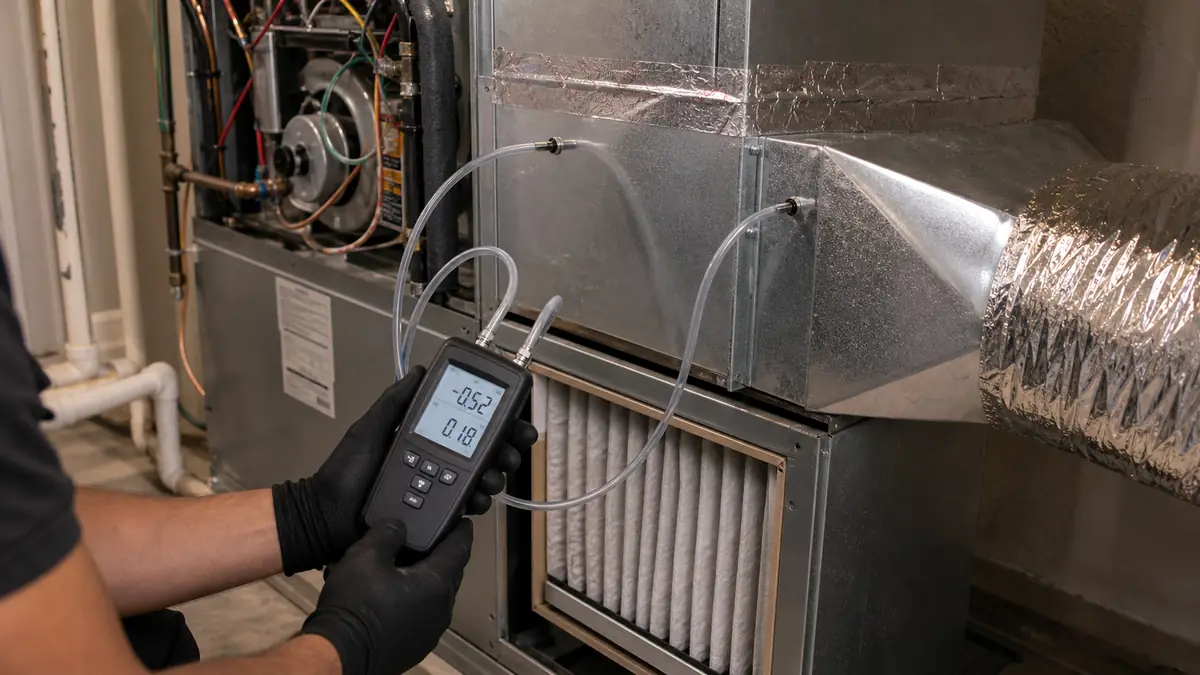
- We read total external static pressure with a manometer across the furnace - return and supply taps. High static confirms an airflow restriction and points us to the duct, filter, or coil.
- We measure the temperature rise across the furnace and compare it to the rating-plate range. A rise above the listed band confirms low airflow even when the filter looks acceptable.
- We clamp blower amperage and inspect the blower wheel; a wheel packed with dust or a weak ECM module moves far less air than its nameplate.
- We inspect the evaporator coil above the furnace - a dirty coil is a hidden restriction that homeowners rarely see.
- Only after airflow checks out do we ohm the high-limit switch itself. A switch that reads open cold, or trips early at normal temperatures, is genuinely failed and gets replaced with the correct Trane part number.
This order matters because replacing a limit switch on an airflow-starved furnace just buys a few weeks before it trips again. The static and temperature-rise numbers are what make the fix stick. For the broader code chart, see Trane furnace error codes; if your ducts are the root restriction, the long-term fix lives on air duct repair and sealing.
When is a 4-flash code urgent?
A single 4-flash trip on a cold night is a comfort problem, not an emergency - the furnace protected itself. It becomes urgent when it trips repeatedly. Each overheat cycle thermally stresses the heat exchanger, and a furnace that limits out several times an hour is heat-cycling steel that was not designed for it. Over years, that stress contributes to cracking, and a cracked heat exchanger is a carbon-monoxide path. Treat it as urgent if the furnace short-cycles on the limit, if you have a working CO alarm sounding, or if you see soot or smell exhaust near the supply registers - shut the furnace off and call. For repeated trips after a filter change, book promptly so a $150 airflow fix does not turn into a heat-exchanger replacement. Reach the shop at (213) 277-6575 or book online, and we will get the airflow and the limit reading correct on the same visit.
Common questions about a Trane 4-flash code in Pasadena
What does 4 flashes mean on a Trane furnace?
Four flashes is an open high-temperature limit. The furnace got hotter than the high-limit switch allows, so the switch opened and cut the burners to protect the heat exchanger. The blower usually keeps running to clear the heat. Almost every time, the root cause is restricted airflow - a clogged filter, dirty coil, or undersized return - not a bad limit switch itself.
Can I fix a Trane 4-flash code myself?
You can fix the most common cause: replace a dirty filter with a clean one of the same size, and open every supply and return register. That restores airflow on most 4-flash calls. What you should not do is jumper out or replace the limit switch - it is a safety device, and bypassing it lets the heat exchanger overheat and crack. If a clean filter does not clear it, book a diagnostic.
Is a 4-flash limit code dangerous?
The code itself is the furnace protecting you - the limit did its job and stopped combustion before the heat exchanger overheated. The danger is ignoring it. Repeated high-limit trips stress the steel heat exchanger through heat cycling and, over time, can contribute to cracking, which is a carbon-monoxide concern. Fixing the airflow promptly keeps a nuisance code from becoming a safety problem.
How much does a Trane 4-flash repair cost in Pasadena?
Most 4-flash calls are airflow and run about $150 to $600 - a filter, coil cleaning, or a return correction. If the high-limit switch itself failed, it is roughly $150 to $350. A weak blower or ECM motor starving airflow runs $450 to $2,300. The diagnostic is $79 to $200 and is credited toward an approved repair, so you are not paying twice.