Trane Furnace Repair in Pasadena
Repair desk - updated 2026-06-13
Quick answer: Pasadena Trane HVAC repairs Trane gas furnaces across Pasadena ZIPs 91101 through 91107, reading the integrated control board's 2-to-9 LED flash codes to pinpoint ignition, pressure-switch, flame-sense, and high-limit faults for about $79 to $200 a diagnostic - so call (213) 277-6575 or book online. We work S9V2 two-stage, XC95m modulating, XV95, and the 80% XR80 and XV80 tiers.
At a glance
- We service S9V2 two-stage, XC95m modulating, XV95, and the 80% XR80/XV80 Trane furnace tiers.
- Diagnostic about $79-$200 (near $139), credited toward the repair.
- Common parts: hot-surface igniter, flame sensor, inducer motor, pressure switch, high-limit, gas valve, control board.
- We diagnose from the control-board LED flash code, then confirm with a meter.
- Furnace replacement, if needed, runs $3,000-$7,500 in 2026 SoCal (80% value to modulating high end).
- Service ZIPs 91101-91107. Hours: Open 6:30am-8pm weekdays, 8am-5pm weekends.
- Independent - not a Trane dealer.
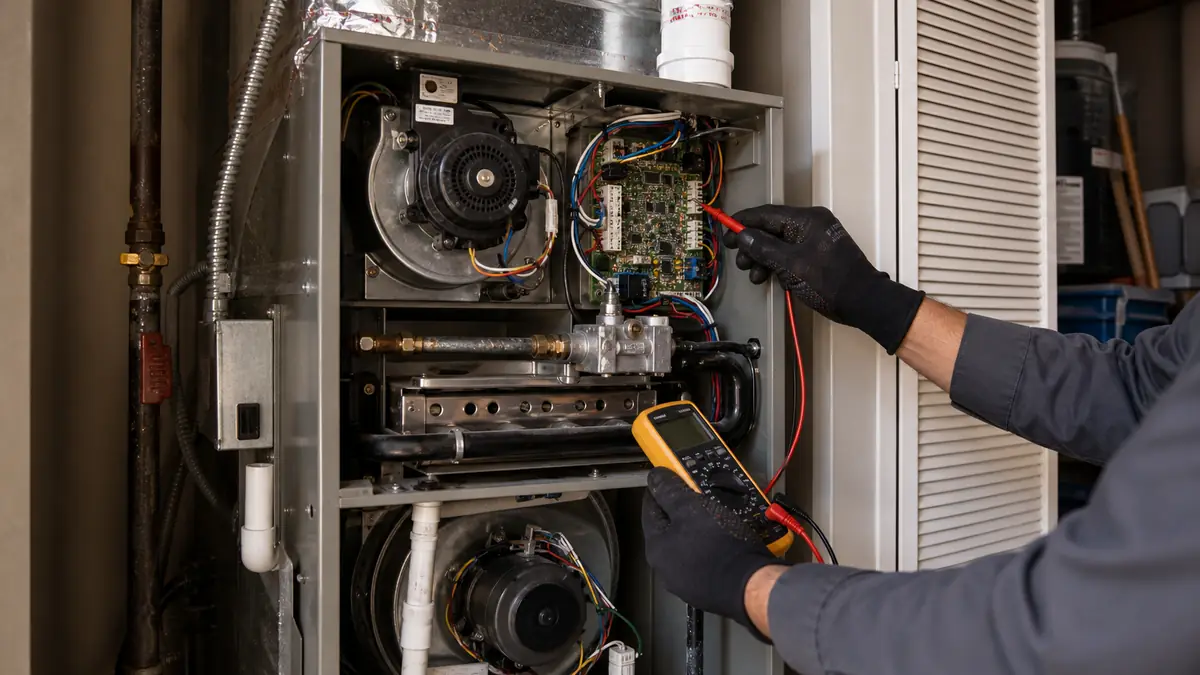
What do Trane furnace flash codes mean?
Trane furnaces report faults through an amber or green status LED on the integrated furnace control. Counting the flashes points us straight at the failed subsystem, which saves diagnostic time and your money. A slow flash is normal standby; a fast flash means a call for heat is active.
| Flash code | Meaning | Likely part / cost lane |
|---|---|---|
| 2 flashes | System lockout (ignition retries/recycles exceeded) | Igniter / flame sensor, $150-$500 |
| 3 flashes | Vent / pressure-switch error (blocked flue, inducer) | Inducer, flue, pressure switch, $150-$700 |
| 4 flashes | Open high-temperature limit (overheating, low airflow) | Dirty filter/coil, blower, $150-$600 |
| 5 flashes | Flame sensed when none should be present (valve leak-by) | Gas valve / control board, $300-$2,000 |
| 6 flashes | 115VAC polarity reversed or poor grounding | Wiring / outlet correction, $80-$300 |
| 7 flashes | Gas valve circuit error | Gas valve / wiring, $300-$900 |
| 8 flashes | Low flame-sense signal (carboned sensor) | Clean/replace flame sensor, $150-$350 |
| 9 flashes | Igniter circuit / line-N to common voltage fault | Hot-surface igniter, $150-$450 |
How does a Trane furnace diagnosis actually go?
A no-heat call follows the same disciplined sequence whether the furnace is a basement 80% XR80 or a closet-mounted modulating XC95m. The flash code points the way; the meter proves the part.
- Read the integrated furnace control (IFC) status LED through the sight glass and count the flash pattern - a fast flash is a normal heat call, a steady pattern of 2 to 9 is a stored fault.
- Confirm the call: 24 volts at the thermostat, then watch the ignition sequence - inducer spins, pressure switch closes, hot-surface igniter glows, gas valve opens, flame sensor proves the burner.
- Isolate the failure with instruments - a microamp meter on the flame sensor (a healthy signal is roughly 2 to 6 microamps), a manometer on the pressure switch and gas manifold, and a clamp meter on the inducer and igniter circuits.
- Replace the proven part - igniter, flame sensor, pressure switch, inducer motor, gas valve, or high-limit - and verify a full clean ignition cycle plus a safe temperature rise across the heat exchanger before we close up.
The instruments are the difference between a repair and a parts-cannon. A 2-flash lockout can be a $150 igniter or a carboned $200 flame sensor; reading the microamp signal tells us which before anything gets swapped.
Which Trane furnace family is in your Pasadena home?
Trane furnaces split into clear tiers, and the tier changes both the likely fault and the venting. Knowing the model from the data plate shortens the visit.
| Family | Stage / AFUE | What differs in service |
|---|---|---|
| XR80 / XV80 (80%) | Single-stage, ~80% AFUE, atmospheric/induced vent | Simple igniter/sensor work; metal flue; most common in older Pasadena homes |
| S9X2 | Two-stage, ~96%, constant-torque ECM | Condensing, PVC vent, condensate drain that can clog |
| S9V2 (S9V2-VS) | Two-stage, ~96%, true variable-speed ECM | ECM module diagnosis; pairs with variable-speed AC/heat pump |
| XV95 | Variable-speed, ~97% | Condensing, sealed combustion, communicating-capable |
| XC95m | Modulating gas valve + variable-speed ECM, ~97.3% | ComfortLink II alerts; modulating valve adds firing-rate logic |
The 80% tier dominates Pasadena's installed base because the mild Zone 9 winter never justified a condensing upgrade for most homes. When an 80% unit fails on a cheap part, repair almost always wins; when a condensing unit shows a cracked exchanger or a failed modulating valve, the replace-versus-repair math gets closer.
Why is airflow the hidden cause of furnace lockouts?
A 4-flash high-limit trip is the code we see most in Pasadena, and the furnace is rarely the real problem - it is overheating because air is not moving through it. The usual culprits are a clogged filter, a dirty AC coil sitting above the furnace, or a tired blower. In older Pasadena homes with undersized 1920s ductwork, high static pressure starves the furnace and trips the limit repeatedly. We measure static pressure and check the duct system before we ever condemn a limit switch.
When is a cracked heat exchanger the answer?
If a furnace short-cycles on the high-limit, shows soot, or the flame rolls out when the blower starts, we inspect the heat exchanger - a crack is a carbon-monoxide safety issue, not a comfort one. On a Pasadena furnace past 15 years with a cracked exchanger, replacement usually beats repair. We will show you the crack and explain the call rather than ask you to take it on faith. Communicating systems with an XL824 or XL850 also surface a plain-language alert.
What does a furnace repair cost in Pasadena, and why?
A repair price is the diagnostic plus the part plus the labor to reach it, and in Pasadena the access is often the swing factor. The diagnostic runs about $79 to $200 (near $139) and is credited toward an approved repair. From there:
- Flame sensor or hot-surface igniter: $150 to $450. The parts are inexpensive; most of the cost is the trip and the careful re-light verification.
- Pressure switch or inducer motor: $150 to $700. A switch is cheap; an inducer motor on a condensing unit pushes the high end.
- Gas valve: $300 to $900. Higher on a modulating XC95m valve than a single-stage 80% valve.
- Control board (IFC) or ECM module: $400 to $2,000. Communicating ComfortLink II boards sit at the top of that lane.
- Full furnace replacement: $3,000 to $7,500 in 2026 SoCal - the 80% tier at the low end, modulating XC95m at the high end.
The Pasadena wrinkle is reach. A furnace tucked into a cramped 1920s Craftsman basement or a tight Spanish-revival closet adds labor that a garage-mounted unit does not. We quote the real number for your install, not a flat-rate guess.
What does Pasadena's housing stock change about a furnace job?
Three local realities shape the work. First, the 1900-1930 Craftsman core and 1920s Spanish revivals were built before forced air, so furnaces and ducts were retrofitted into tight basements, hall closets, and attics - access drives both diagnosis time and replacement cost. Second, the undersized retrofit ductwork that is so common here starves the blower and trips the 4-flash high-limit, which is why we measure static pressure rather than blaming the limit switch. Third, California air-district NOx rules and condensing-furnace PVC venting affect any change-out off an old atmospheric unit, so we confirm the new model and its vent path meet current code before the job, not after the inspector arrives.
Common questions about Trane furnace repair in Pasadena
My Trane furnace blinks 3 times - what does that mean?
On a Trane integrated furnace control, 3 flashes signals a vent or pressure-switch error: a blocked flue, a failing inducer motor, or a stuck pressure switch. We check the inducer draw and the flue first. Two flashes is a hard ignition lockout, and 4 flashes is an open high-limit, usually from low airflow.
Why does my furnace light then shut off after a few seconds?
That is classic flame-sense failure, often an 8-flash low-flame-signal code. The flame sensor is a metal rod that proves the burner lit; when it carbons over, the board reads no flame and shuts the gas for safety. Cleaning or replacing the sensor usually fixes it inexpensively.
Do Pasadena homes even need a high-efficiency furnace?
Often not. Pasadena's mild Zone 9 winters mean an 80% AFUE Trane furnace (the XR80/XV80 tier) is frequently adequate, and a modulating XC95m pays back slowly here compared to colder regions. We size and recommend based on your actual heating hours, not a sales target.
How long does a Trane furnace repair take?
Most common repairs - flame sensor, igniter, pressure switch - are done in one visit of one to two hours once we read the flash code and confirm the part. An inducer motor or gas valve runs longer, and a control board may need to be sourced if it is a communicating ComfortLink II unit.
Is it safe to keep running a furnace that locks out?
It depends on the code. A 4-flash high-limit or a 3-flash pressure-switch fault is the furnace protecting itself, but a repeated lockout, soot, or any rollout signal points toward a heat-exchanger or venting problem that can release carbon monoxide. If you smell gas or the unit short-cycles on a safety, shut it off and call us.
Can you repair a furnace and AC coil on the same visit?
Usually yes, since the evaporator coil sits in the supply plenum on the furnace and the same blower serves both. A no-heat call in winter often surfaces a dirty AC coil or a blower fault that will also hurt cooling, so we check the shared air path while we are there.